

Best BBs for Airsoft: Weight, Quality and Accuracy Explained
For most standard airsoft AEGs, 0.25g bio BBs are the best all-round choice. They usually fly more stable than 0.20g BBs, perform better outdoors and still work well in most stock replicas. For upgraded AEGs, DMR-style builds and outdoor play, 0.28g to 0.32g BBs can give better consistency, provided your hop-up can lift them properly. Snipers often use even heavier BBs, such as 0.36g, 0.40g or above, depending on the replica, field limits and hop-up setup.
The most important rule is simple: do not choose BBs only by price. A cheap, badly polished or inconsistent BB can cause jams, poor accuracy and unnecessary wear. A good airsoft BB should be round, smooth, consistent in weight and diameter, and suitable for your replica.
At Shogun, we usually advise players to see BBs as part of the performance setup, not as a disposable afterthought. Your replica, hop-up, barrel, power output, playing distance and field type all influence which BB weight works best.
Why BB choice matters more than most players think
Many airsoft players spend a lot of time choosing a replica, optic, magazine or tactical vest, but then grab the cheapest bottle of BBs they can find. That is a mistake.
BBs are the only part of your setup that physically travels through the barrel and toward the target. That means their weight, shape, polish and consistency affect almost everything you notice during a skirm.
- How straight your shots fly
- How consistent your grouping is
- How well your hop-up works
- How your replica performs in wind
- How often you deal with feeding issues
- How much confidence you have in each shot
A high-quality BB will not magically turn a bad replica into a perfect one, but a poor BB can make even a good replica perform badly.

|

|

|
Shogun Expert Note
From Shogun’s experience, one of the most common mistakes newer players make is assuming that lighter BBs are always better because they leave the barrel faster. In practice, a slightly heavier BB often gives a more stable flight path, especially outdoors. Edwin and Michiel would usually look at the full setup first: the replica, the hop-up, the FPS or joule output, the player’s field type and the desired range.
The best BB is not always the heaviest BB. It is the BB your replica can lift consistently and shoot accurately.
Quick BB weight recommendation table
Use this table as a practical starting point. Always test your own replica, because hop-up quality, barrel condition and local field limits can change the ideal choice.
| Replica or setup | Common starting BB weight | Best used for | Shogun advice |
|---|---|---|---|
| Entry-level spring pistol | 0.12g to 0.20g | Backyard plinking or very low-power use | Avoid 0.12g for serious airsoft replicas |
| Standard AEG | 0.25g | Most beginners, indoor and outdoor play | Best all-round starting point for many players |
| Stock AEG with decent hop-up | 0.25g to 0.28g | Outdoor games, better stability | Try both and compare grouping |
| Upgraded AEG | 0.28g to 0.32g | More consistent outdoor shots | Only use if the hop-up lifts them well |
| GBB pistol | 0.25g to 0.28g | Sidearm use, CQB, medium distance | Gas efficiency and hop-up quality matter |
| GBB rifle | 0.28g to 0.32g | Realistic play, medium distance | Test carefully because gas performance changes with temperature |
| DMR-style replica | 0.30g to 0.36g | Longer range, precision | Field rules and joule limits are important |
| Sniper rifle | 0.36g to 0.45g+ | Long-range precision | Needs a strong and well-tuned hop-up |
| Tracer setup | 0.20g to 0.28g tracer BBs | CQB, dark environments, night games | Choose quality tracer BBs, not just the brightest option |
0.20g vs 0.25g vs 0.28g BBs
0.20g BBs
0.20g BBs are often seen as the classic beginner weight. They are light, common and usually used for basic FPS testing in many airsoft contexts. They can work well in low-power replicas, simple pistols or short indoor distances.
But they are not always the best choice for real skirms.
Because they are lighter, they are more easily affected by wind and small inconsistencies. Outdoors, they may curve, rise too much or lose stability faster than slightly heavier BBs.
Best for
- Low-power replicas
- Some pistols
- Basic testing
- Short indoor distances
- Players who are still learning how their replica behaves
Be careful with
- Outdoor play
- Windy fields
- Medium to long range
- Over-hopping
- Poor grouping
0.25g BBs
For many players, 0.25g is the ideal all-round BB weight. It gives more stability than 0.20g, while still being light enough for most standard AEGs and GBB pistols to lift properly.
If someone buys their first serious AEG from Shogun and wants one BB weight to start with, 0.25g is often the safest recommendation.
Best for
- Standard AEGs
- Beginner to intermediate players
- Mixed indoor and outdoor play
- More stable shots than 0.20g
- Players who do not want to overcomplicate their setup
Shogun advice
If you are unsure, start with high-quality 0.25g BBs. Then test 0.28g bio BBs later if you play outdoors often and want more stable flight.
0.28g BBs
0.28g BBs are a strong next step for players who want better stability and accuracy outdoors. Many decent AEGs can handle them, but not all stock replicas will lift them perfectly.
A 0.28g BB usually travels a bit slower than a 0.25g BB, but the flight path can be more predictable. That matters more than raw speed when you are trying to hit a player at medium distance.
Best for
- Outdoor fields
- Better AEGs
- Players who value grouping
- Slightly upgraded hop-up setups
- Windier conditions
Be careful with
- Weak hop-up units
- Very low-power replicas
- Expecting more weight to solve every accuracy problem
Detailed BB weight table
| BB weight | Typical use | Strengths | Weaknesses | Shogun verdict |
|---|---|---|---|---|
| 0.12g | Very low-power toy-grade replicas | Cheap and light | Not suitable for serious airsoft replicas | Avoid for normal skirms |
| 0.20g | Basic pistols, testing, low-power setups | Common, fast, easy to find | Less stable outdoors | Usable, but not our favorite all-round choice |
| 0.23g | Light upgrade from 0.20g | Slightly more stable | Less common than 0.25g | Fine, but 0.25g is usually easier |
| 0.25g | Standard AEGs and many pistols | Great all-round balance | May be too light for precision builds | Best starting point for many players |
| 0.28g | Outdoor AEGs, better hop-ups | More stable flight | Needs a decent hop-up | Excellent next step |
| 0.30g | Upgraded AEGs, GBBRs, DMR-style setups | Better consistency at range | Slower, needs good hop | Great for serious outdoor players |
| 0.32g | DMR, tuned rifles, some GBBRs | Strong wind resistance | Not ideal for weak setups | Use when your replica can handle it |
| 0.36g | DMR and sniper use | Stable and precise | Requires strong hop-up | Specialist weight |
| 0.40g+ | Sniper rifles and high-end precision builds | Long-range consistency | Expensive, specialist use | Only for tuned setups |
BB quality: what makes a good airsoft BB?
BB weight matters, but quality matters just as much.
A good BB should be:
- Smooth
- Round
- Consistent in weight
- Consistent in diameter
- Well polished
- Free from seams, cracks, dimples or bubbles
- Compatible with your magazine and barrel
- Stored properly
Poor BBs can cause several problems:
- Barrel jams
- Feeding issues
- Random flyers
- Poor grouping
- Hop-up inconsistency
- Scratches or dirt inside the barrel
- Frustration during games
Shogun Expert Note
Michiel’s practical advice would be simple: if your replica suddenly shoots left, right, up and down for no clear reason, do not immediately blame the gearbox or hop-up. First check the BBs, clean the barrel and test a known quality BB weight. In many cases, the problem is not the replica itself, but the combination of cheap BBs, dirty barrel and badly adjusted hop-up.
The hidden cost of cheap BBs
Cheap BBs look attractive because you get more rounds for less money. But in airsoft, the cheapest BB can become expensive quickly.
A single bad BB can:
- Jam inside the barrel
- Cause misfeeds
- Damage internal parts if the replica keeps cycling
- Ruin your accuracy during a skirm
- Make you think your replica is broken
- Waste more BBs because you need more shots to hit
This is why Shogun normally recommends quality BBs from reliable brands, especially if you use a decent AEG, upgraded replica, GBBR, DMR or sniper.
A good rule: the better your replica, the less sense it makes to use cheap BBs.
Bio BBs vs regular BBs
Many airsoft fields require biodegradable BBs, especially outdoor fields. Bio BBs are designed to break down more responsibly over time under the right environmental conditions.
For most players, high-quality bio BBs are the logical choice. The performance difference between good bio BBs and regular BBs is usually small. The bigger difference is between good BBs and bad BBs.
Bio BB advantages
- Often required by outdoor fields
- Better choice for the environment
- Available in many weights
- Available as tracer BBs
- Suitable for serious play when quality is good
Bio BB disadvantages
- Usually slightly more expensive
- Sensitive to poor storage
- Cheap bio BBs can be inconsistent
- Some low-quality bio BBs may leave residue or deform
Storage advice for bio BBs
Store bio BBs:
- Dry
- Cool
- Away from direct sunlight
- In a closed bottle or bag
- Away from moisture
- Not loose in a dirty pouch or backpack
Do not leave bio BBs in a hot car, damp shed or open container for long periods.
Which BB weight should you use for indoor airsoft?
For indoor airsoft and CQB, distances are shorter. You often do not need very heavy BBs.
| Indoor setup | Recommended BB weight | Why |
|---|---|---|
| Standard AEG | 0.20g to 0.25g | Short distances and quick target transitions |
| Better AEG | 0.25g | More stable without becoming too slow |
| GBB pistol | 0.20g to 0.25g | Depends on hop-up and gas performance |
| Tracer setup | 0.20g to 0.25g tracer | Easy to track shots in dark CQB areas |
| Speedsoft-style setup | 0.20g to 0.25g | Fast play, short distances |
Shogun advice for CQB
For CQB, do not overthink range. Focus on reliable feeding, clear visibility, proper eye protection and BBs that your replica shoots consistently. A high-quality 0.25g BB is often more useful than chasing a heavier weight you do not need indoors.
Which BB weight should you use outdoors?
Outdoor airsoft is where BB choice becomes much more important. Wind, distance, branches, uneven terrain and longer engagement ranges all expose weak BB choices.
| Outdoor setup | Recommended BB weight | Why |
|---|---|---|
| Beginner AEG | 0.25g | Reliable all-round starting point |
| Better stock AEG | 0.25g to 0.28g | More stable at medium range |
| Upgraded AEG | 0.28g to 0.32g | Better grouping and wind resistance |
| DMR-style setup | 0.30g to 0.36g | More consistent at longer distance |
| Sniper rifle | 0.36g to 0.45g+ | Precision and stability |
| GBBR | 0.28g to 0.32g | Stronger stability, but test in different temperatures |
Shogun advice for outdoor players
If you currently use 0.20g outdoors and your shots seem to float or curve too easily, try quality 0.25g first. If your replica handles that well, test 0.28g. Do not jump straight to heavy BBs without testing your hop-up.
How hop-up affects BB choice
Your hop-up puts backspin on the BB. This backspin helps the BB stay in the air longer and fly flatter.
A heavier BB needs more hop-up effect to lift properly. That means the best BB weight depends partly on your hop-up unit, bucking, nub and overall replica setup.
Signs your BB is too light
- BBs rise too much
- Shots curve unpredictably
- Wind pushes them easily
- You get poor stability at distance
- The replica feels accurate only at short range
Signs your BB is too heavy
- BBs drop too soon
- You cannot adjust enough hop to lift them
- Range becomes worse, not better
- Shots feel slow and inconsistent
- You need to aim much higher than expected
Signs your BB weight is right
- Flight path is stable
- Grouping is tighter
- Hop-up adjustment sits in a usable range
- BBs do not climb excessively
- BBs do not drop too early
- You can predict where your shots will land
Practical test: how to find the best BB weight for your replica
Do not guess. Test.
Use this simple Shogun-style method:
- Clean your barrel first.
- Use a stable shooting position.
- Choose a realistic target distance.
- Test 0.25g, 0.28g and 0.30g if your replica is suitable.
- Adjust hop-up for each weight.
- Shoot groups of 10 to 20 BBs.
- Compare grouping, not just distance.
- Choose the BB that gives the most predictable result.
Test table
| Test factor | What to look for | Best result |
|---|---|---|
| Grouping | How close shots land together | Smaller group |
| Flight path | Whether BBs fly straight | Predictable path |
| Hop-up range | Whether adjustment is comfortable | Not maxed out |
| Wind behavior | How much the BB drifts | Less drift |
| Feeding | Whether magazines feed reliably | No misfeeds |
| Confidence | Whether you trust each shot | High confidence |
Shogun Expert Note
Edwin’s practical approach would be to avoid selling upgrades before the basics are right. If a player wants more accuracy, the first questions should be: which BBs are you using, when did you last clean the barrel, and is the hop-up adjusted properly? Only after that does it make sense to talk about internal upgrades.
BBs and joule limits
Airsoft fields often use FPS or joule limits for safety. Heavier BBs can change how energy is measured and experienced.
This is why you should always follow the rules of the field where you play. Do not assume that changing BB weight is just a harmless accuracy tweak. The field’s chronograph procedure and joule limits matter.
Important
- Always chrono according to field rules.
- Do not try to bypass limits with BB weight.
- Use the BB weight you actually play with if the field requires that for testing.
- Respect MED rules and safety distances.
- Ask marshals if you are unsure.
Shogun’s advice is simple: performance is important, but safety and fair play come first.
BBs for AEG replicas
For most AEG players, 0.25g is the best starting point.
If your AEG is basic, stock and used mostly indoors, 0.20g or 0.25g can work. If you play outdoors and want better stability, 0.25g or 0.28g is usually a better choice.
Recommended AEG approach
| AEG type | Start with | Test next |
|---|---|---|
| Basic entry-level AEG | 0.25g | 0.20g if hop is weak |
| Standard AEG | 0.25g | 0.28g |
| Better stock AEG | 0.25g | 0.28g to 0.30g |
| Upgraded AEG | 0.28g | 0.30g to 0.32g |
| DMR-style AEG | 0.30g | 0.32g to 0.36g |
Common AEG mistake
Many players upgrade the motor, spring or barrel before they test better BBs. Sometimes a simple switch from low-quality 0.20g BBs to high-quality 0.25g or 0.28g BBs gives a more noticeable improvement than expected.
BBs for GBB pistols and GBB rifles
Gas blowback replicas are more sensitive to temperature, gas pressure, magazine condition and hop-up quality.
For many GBB pistols, 0.25g is a good starting point. Some pistols perform well with 0.28g, especially outdoors. GBB rifles often benefit from 0.28g to 0.32g BBs, but testing is important.
| GBB type | Suggested BB weight | Notes |
|---|---|---|
| GBB pistol CQB | 0.20g to 0.25g | Short distances, fast shots |
| GBB pistol outdoor | 0.25g to 0.28g | Better stability |
| GBB rifle | 0.28g to 0.32g | Depends on hop-up and temperature |
| Upgraded GBBR | 0.30g to 0.36g | Specialist testing recommended |
Shogun advice
With GBB replicas, do not judge performance on one cold magazine. Test with a stable gas, proper temperature and well-maintained magazines. A BB weight that works well in summer may feel different in cold weather.
BBs for sniper rifles
Sniper rifles usually need heavier BBs because precision and consistency are more important than quick follow-up shots.
A typical sniper setup may use 0.36g, 0.40g, 0.43g or heavier BBs, depending on the replica, spring, hop-up and field limits.
Sniper BB advice
| Sniper setup | Suggested BB weight |
|---|---|
| Entry-level sniper | 0.30g to 0.36g |
| Upgraded sniper | 0.36g to 0.43g |
| High-end tuned sniper | 0.43g+ |
Important
A heavy BB only works if the hop-up can lift it consistently. If your sniper cannot hop the BB properly, heavier is not better.
BBs for DMR setups
DMR-style replicas sit between standard rifles and sniper rifles. They are built for more controlled shots at longer distances.
For DMR-style builds, 0.30g bio BBs to 0.36g is often a useful testing range, but field rules are very important. Many fields have specific DMR limits, minimum engagement distances and rules about full-auto locking.
DMR checklist
Before choosing heavy BBs, check:
- Field joule limit
- DMR classification rules
- Minimum engagement distance
- Hop-up quality
- Barrel cleanliness
- Magazine feeding
- BB brand consistency
Tracer BBs: when should you use them?

|

|

|
Tracer BBs glow when used with a tracer unit. They are very useful in CQB, dark indoor fields, night games and low-light areas.
Tracer BBs are not only for looks. They help you see where your shots go, which makes it easier to adjust aim and understand your replica’s flight path.
Tracer BB table
| Situation | Recommended tracer BB |
|---|---|
| Indoor CQB | 0.20g to 0.25g |
| Dark corridors | 0.20g to 0.25g |
| Outdoor night game | 0.25g to 0.28g |
| More serious outdoor setup | 0.28g tracer, if available and compatible |
Shogun advice
Do not buy tracer BBs only because they glow brightly. They still need to be consistent, polished and reliable. A bad tracer BB is still a bad BB.
White, dark, green or tracer BBs?
BB color is partly about visibility.
| BB type | Best for | Notes |
|---|---|---|
| White BBs | General use | Easy to see in daylight |
| Dark BBs | Concealment | Harder to track your own shots |
| Green tracer BBs | CQB and night play | Very common and visible |
| Red tracer BBs | Specific tracer setups | Check compatibility |
| Bio BBs | Outdoor fields | Often required |
| Non-bio BBs | Some indoor fields | Check local rules |
For most players, white bio BBs are the most practical all-round choice for outdoor play. For indoor CQB with a tracer unit, 0.25g green tracer BBs are popular because they are easy to follow.
How many BBs do you need for a skirm?
This depends on how you play.
| Player type | Typical BB use per day | Notes |
|---|---|---|
| Careful beginner | 1,000 to 2,000 BBs | Controlled shooting |
| Average AEG player | 2,000 to 4,000 BBs | Normal skirm use |
| High-cap heavy player | 4,000+ BBs | More suppressive fire |
| Sniper | 200 to 800 BBs | Fewer, more deliberate shots |
| GBB player | 500 to 1,500 BBs | Limited by magazines and gas |
| CQB tracer player | 1,500 to 3,000 BBs | Depends on game speed |
Shogun advice: bring more than you expect to use, but do not carry everything on your body. Keep extra BBs in your bag or staging area and refill between games.
Common BB problems and what they mean
| Problem | Possible cause | What to check first |
|---|---|---|
| BBs curve left or right | Dirty barrel, poor BBs, hop-up issue | Clean barrel, test quality BBs |
| BBs fly up too much | Too much hop or BB too light | Reduce hop or test heavier BB |
| BBs drop too soon | Too little hop or BB too heavy | Increase hop or test lighter BB |
| Random flyers | Poor BB quality or dirty barrel | Use better BBs, clean barrel |
| Misfeeds | Magazine, BB size, dirty chamber | Test another magazine and BB brand |
| Barrel jam | Bad BB, dirt, damaged BB | Stop shooting and clear safely |
| Poor range | Hop-up, BB weight, low power | Test hop and BB weight |
| Inconsistent grouping | BB quality, wind, replica setup | Test controlled groups |
What BBs should beginners buy first?
For a first serious airsoft replica, especially an AEG, Shogun’s simple beginner advice is:
Buy high-quality 0.25g bio BBs.
This gives you a good balance of:
- Stability
- Compatibility
- Accuracy
- Outdoor usability
- Easy availability
- Lower risk of frustration
If you play indoor only, you may also test 0.20g. If you play outdoors often and your replica performs well, test 0.28g next.
Beginner shopping checklist
When buying BBs, check:
- Weight: 0.25g is a safe starting point
- Bio or non-bio: choose bio if your field requires it
- Brand quality: avoid unknown cheap BBs
- Bottle or bag: bottles are easier to pour
- Tracer or normal: only buy tracer if you use a tracer unit
- Storage: keep them dry and clean
What BBs should intermediate players test?
If you already know your replica and want better performance, test multiple weights.
A good test set:
- 0.25g
- 0.28g
- 0.30g
For stronger or upgraded replicas:
- 0.30g
- 0.32g
- 0.36g
Do not test by feeling alone. Shoot groups, adjust hop-up, and compare results.
What BBs should you avoid?
Avoid BBs that are:
- Extremely cheap
- Visibly rough
- Seamed
- Cracked
- Dirty
- Damp
- Old and poorly stored
- Unknown in quality
- Too light for your outdoor setup
- Too heavy for your hop-up
Also avoid mixing random BBs in one bottle. If you mix weights, your shots become unpredictable because each BB may fly differently.
Shogun’s practical BB decision tree
Step 1: What replica do you use?
- Standard AEG: start with 0.25g
- GBB pistol: start with 0.25g
- Outdoor AEG: test 0.25g and 0.28g
- DMR: test 0.30g and above
- Sniper: test 0.36g and above
Step 2: Where do you play?
- Indoor: 0.20g to 0.25g
- Outdoor: 0.25g to 0.30g
- Long range: 0.30g+
- Night/CQB: tracer BBs
Step 3: Can your hop-up lift the BB?
- Yes: test grouping
- No: go lighter or improve hop-up
- Almost: try a small weight step down
Step 4: Are your shots consistent?
- Yes: you found a good match
- No: clean barrel, check BB quality, adjust hop-up and retest
Recommended all-round BBs for most players
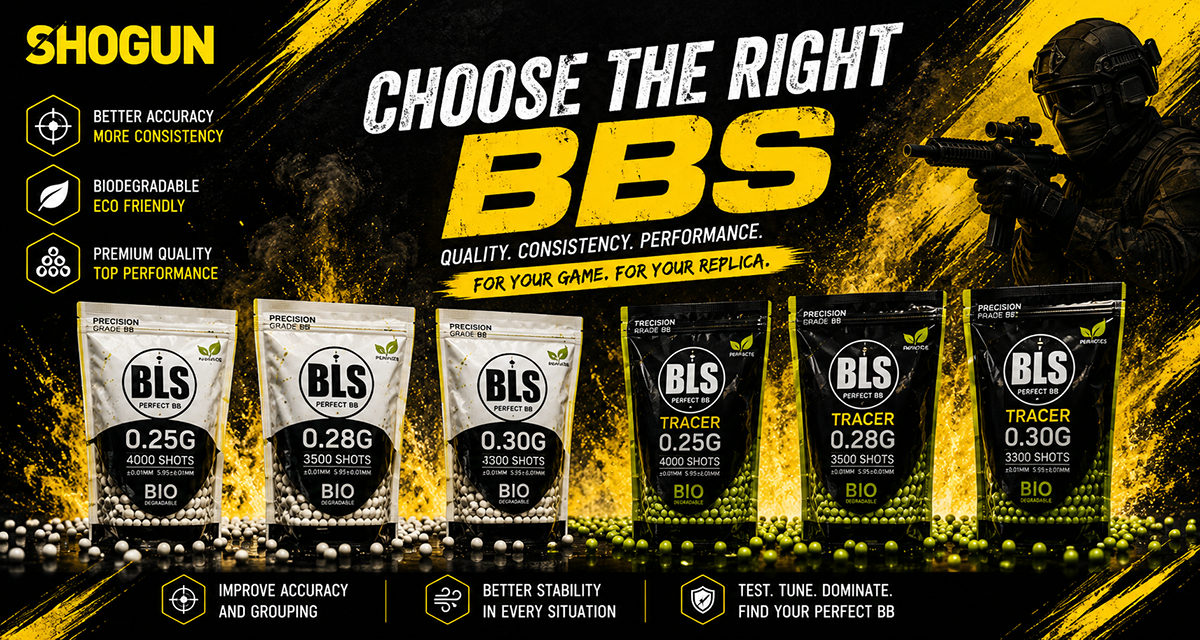
Not sure where to start? For many standard AEGs and beginner setups, high-quality 0.25g bio BBs are the safest first choice. They offer a strong balance between stability, compatibility and ease of use.
- BLS 0.25g Bio BBs 4000 White - best all-round starting point for many AEG players.
- BLS 0.25g Bio Tracer BBs 4000 Green - ideal for CQB, indoor fields and tracer units.
For better outdoor consistency
If your replica can lift them properly, 0.28g bio BBs and 0.30g bio BBs can improve stability and grouping outdoors.
- BLS 0.28g Bio BBs 3500 White - a strong next step for outdoor AEG players.
- BLS 0.30g Bio BBs 3300 White - useful for stronger setups, DMR-style builds and players who want more stability.
Recommended tracer BBs for CQB and night games
If you use a tracer unit, green tracer BBs make it much easier to see your shots in dark CQB areas, indoor fields and night games. Choose the weight based on your replica and playing distance.
- BLS 0.25g Bio Tracer BBs 4000 Green - the most logical all-round tracer choice for many CQB and indoor players.
- BLS 0.28g Bio Tracer BBs 3500 Green - a good option for players who want more outdoor stability with tracer visibility.
- BLS 0.30g Bio Tracer BBs 3300 Green - best suited for stronger setups that can properly lift heavier tracer BBs.
For precision builds
DMR and sniper setups usually perform best with heavier BBs, but only when the hop-up and field limits match the setup.
Useful product categories to consider:
- 0.32g BBs
- 0.36g BBs
- 0.40g+ BBs
- Hop-up parts
- Maintenance tools
Frequently asked questions about airsoft BBs
What is the best BB weight for airsoft?
For most standard AEGs, 0.25g is the best all-round BB weight. It usually gives better stability than 0.20g while still working well in many stock replicas. Outdoor players may want to test 0.28g if their hop-up can handle it.
Are heavier BBs more accurate?
Heavier BBs can be more stable and more consistent, especially outdoors, but only if your replica can lift them properly with the hop-up. If the BB is too heavy for your setup, range and accuracy can become worse.
Are 0.20g BBs bad?
No, 0.20g BBs are not automatically bad. They can work in low-power replicas, pistols and indoor settings. However, many outdoor AEG players get better stability from 0.25g or 0.28g BBs.
What BBs should I use for a beginner AEG?
Start with high-quality 0.25g BBs. If you mostly play indoors, you can also test 0.20g. If you play outdoors and your replica shoots well, try 0.28g and compare the grouping.
What BBs should I use for a sniper rifle?
Many airsoft sniper rifles use heavier BBs such as 0.36g, 0.40g or above. The right choice depends on the hop-up, power, field rules and tuning of the rifle.
Are bio BBs worse than regular BBs?
Good bio BBs can perform very well. The problem is not bio BBs themselves, but low-quality BBs. Choose a reliable brand and store bio BBs dry, cool and sealed.
Can cheap BBs damage my airsoft replica?
Yes, poor-quality BBs can cause jams, misfeeds and inconsistent shots. A badly shaped or dirty BB can get stuck in the barrel or hop-up area. Always use smooth, polished, high-quality BBs.
Can I mix BB weights?
It is better not to mix BB weights. Different weights fly differently, which makes your shots unpredictable. Keep each bottle or speedloader filled with one BB weight.
Why do my BBs curve left or right?
Common causes include a dirty barrel, poor BB quality, wind, damaged hop-up rubber or incorrect hop-up adjustment. Start by cleaning the barrel and testing high-quality BBs.
Do tracer BBs perform differently?
Tracer BBs can perform well if they are high quality. Their main advantage is visibility in dark environments. Use them with a compatible tracer unit and choose the right weight for your setup.
Conclusion: choose BBs as part of your setup, not as an afterthought
The best airsoft BB is not simply the cheapest, heaviest or fastest option. It is the BB that works best with your replica, hop-up, field type and playing style.
For most players, Shogun’s practical advice is:
- Start with quality 0.25g BBs for a standard AEG
- Test 0.28g if you play outdoors and want more stability
- Use heavier BBs only if your hop-up can lift them properly
- Choose bio BBs when your field requires them
- Avoid cheap, inconsistent or badly stored BBs
- Clean your barrel before blaming the replica
- Test grouping, not just distance
A good BB gives you more than a better shot. It gives you confidence. And in airsoft, confidence in your setup can make the difference between guessing and hitting.
Final Shogun Expert Note
Edwin and Michiel’s practical view is clear: before you spend money on upgrades, make sure the basics are right. Good BBs, a clean barrel, a correctly adjusted hop-up and reliable magazines often solve more problems than players expect. Start there, test properly and build your setup step by step.